Surfaces, formats and the shape of a season
The calendar is not a list of tournaments. It is a rotation of surfaces and formats, and each swing rewards a different kind of player.
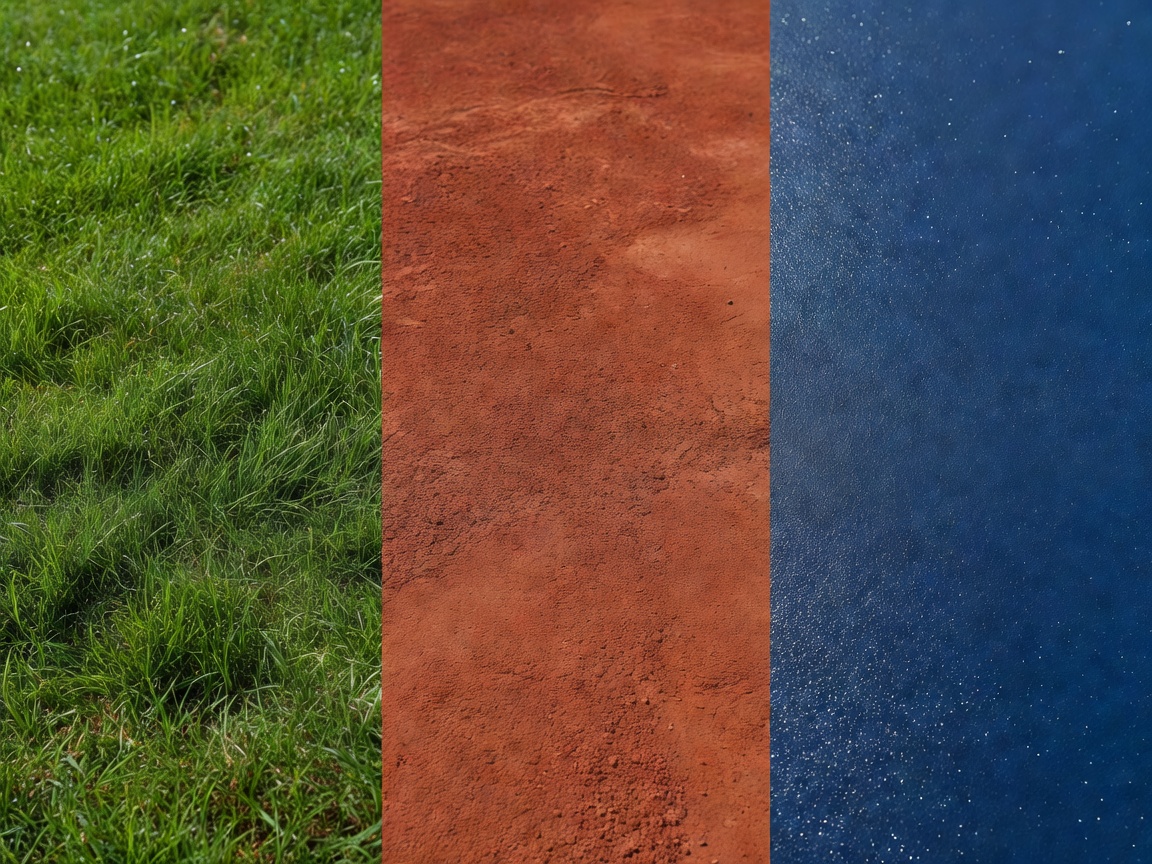
The rotation
Broadly, the professional year opens on hard courts with the Australian Open, moves to clay through the European spring and Roland-Garros, turns to a short grass block around Wimbledon, returns to hard courts in North America for the US Open, and closes indoors. The precise weeks and event line-up are published by the tours each year; treat the shape as stable and the detail as something to check.
For a young player, the rotation is a series of restarts. Just as the footwork settles on one surface, the next swing begins.
What each swing asks for
| Swing | Rewards | Punishes |
|---|---|---|
| Hard court | First-strike patterns, reliable serve, clean timing | Poor recovery footwork; joints under repeated load |
| Clay | Patience, sliding, heavy topspin, fitness | Flat hitters with no plan B; thin match fitness |
| Grass | Low base, slice, forward movement, serve accuracy | Deep returners and slow first steps |
| Indoor hard | Serve dominance, flat drives, quick decisions | Rally-reliant defenders with little offence |
Formats: three sets and five
Men's singles at the four majors is best of five sets. Nearly everywhere else on both tours, singles is best of three. That difference reshapes the match: in five sets, a young player's fitness, food and recovery routines become part of the contest, and a slow start is survivable in a way it is not over three.
Tie-break conventions, particularly in final sets, have been revised more than once and can vary by event. Check the tournament's own rules rather than assuming.
Speed is not just the surface
Court pace depends on more than the material. The ball used, the altitude of the venue, the temperature and humidity, whether the roof is closed, and how recently the court was laid all change how the ball behaves. Two hard-court events in the same swing can play very differently.
Practical reading: when a player suddenly looks better or worse from one week to the next, conditions are a likelier explanation than form.
The load a season puts on a body
Qualifying weeks sit on top of main-draw weeks. A player who qualifies plays several extra matches before the tournament proper begins, then travels, then does it again. Add long-haul flights between swings, time zones, and the temptation to enter one more event to chase points.
Signs a schedule has gone wrong tend to appear in the same order: sharp drop in second-serve quality, then shorter rallies, then mid-match retirements or late withdrawals. None of that is a character flaw. It is arithmetic.
Team competitions in the calendar
Davis Cup, the Billie Jean King Cup and the United Cup occupy their own windows. For a young player these weeks are valuable exposure and extra load at the same time, and they often fall immediately before or after a major swing.
Reading a season for progress
- Split the year into swings rather than counting tournaments.
- Within each swing, look for one result better than the player's usual level.
- Check whether the improvement carried into the next swing or vanished with the surface.
- Note the autumn. Indoor results after a long summer say a lot about durability.
- Look at the off-season block. A player who used it for physical work often looks different in the new year.
Why surface breadth matters more than a single peak
A player can be excellent on one surface and still struggle to build a ranking, because the calendar only gives that surface a few weeks. Breadth — competent everywhere, strong somewhere — tends to produce steadier progress than a specialist profile, at least until the specialist reaches a level where they can afford to skip swings.
Where to check the calendar
Event lists, surface designations, draw sizes and format rules are published by the governing bodies: the ATP, the WTA and the ITF. Individual tournaments publish their own conditions of play, which is the level of detail worth reading before drawing conclusions about a result.
Last note. Surfaces explain more early-career volatility than almost anything else. Before deciding a young player has stalled, check what they were standing on.
Back to the index: the five notes.